



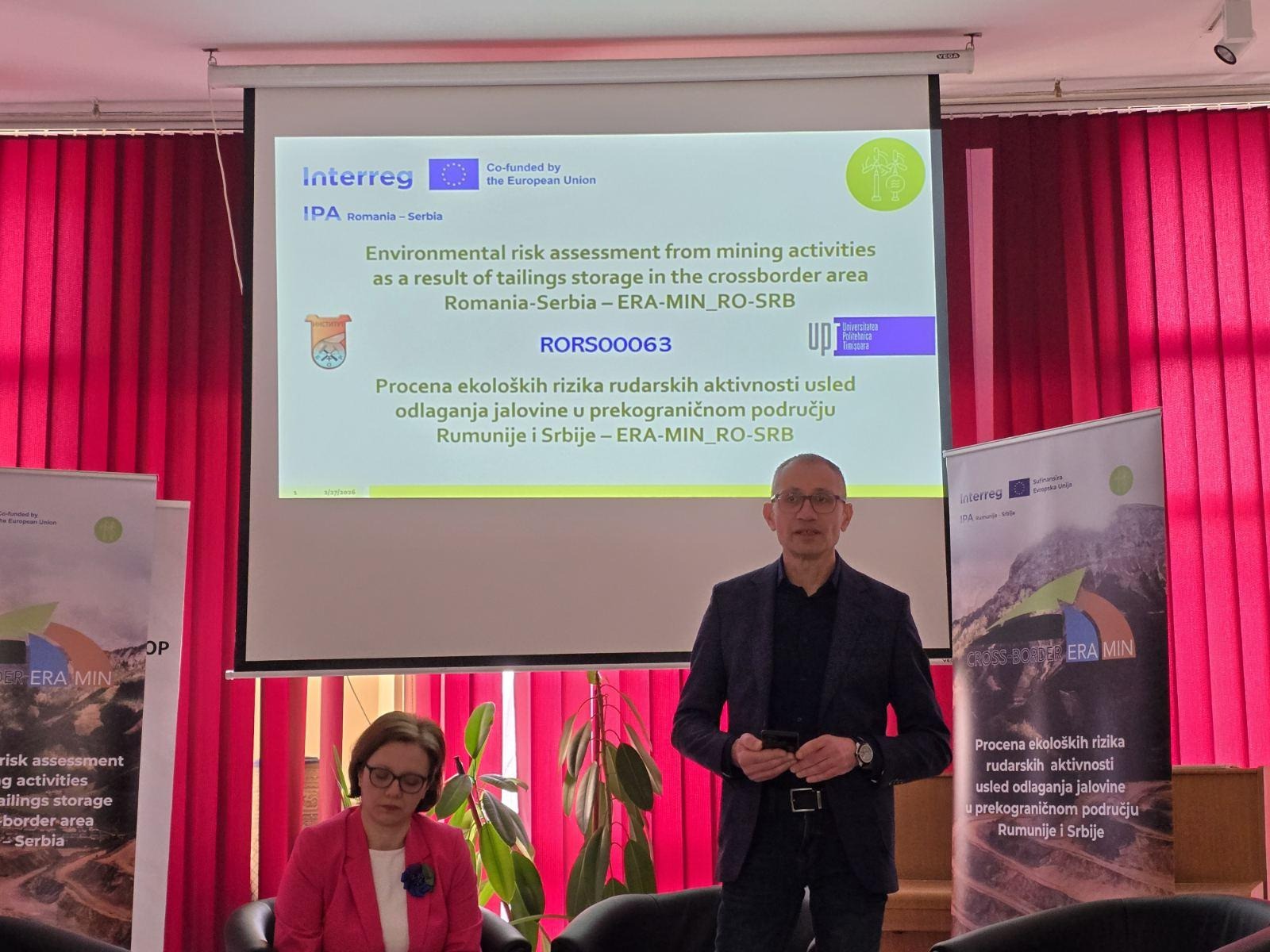
On February 27, 2026, Bor became a regional center of European scientific and professional cooperation, demonstrating how the European Union concretely invests in knowledge, environmental protection, and a safer future for citizens.
The third workshop of the international project “Environmental Risk Assessment from Mining Activities as a Result of Tailings Storage in the Cross-Border Area Romania–Serbia (ERA-MIN_RO-SRB)” was held at the National Library in Bor. The project is funded by the European Union through the IPA Romania–Serbia Cross-Border Cooperation Programme.

The workshop was opened by Dr. Daniel Kržanović, Project Coordinator from the Mining and Metallurgy Institute Bor. He emphasized that the project represents a synergy of science, institutional cooperation, and social responsibility. Seasonal sampling, field research, and laboratory analyses have been successfully completed, and comprehensive environmental and health risk assessment studies are in preparation.

A significant contribution was made by Dr. Nicoleta Nemeș Sorina from the Polytechnic University of Timișoara, who presented the results of the autumn–winter monitoring campaign. She highlighted the importance of systematic and continuous environmental monitoring and cross-border data integration, as environmental challenges do not recognize administrative borders.

A significant contribution to the scientific segment of the program was also made by Miloš Stojanović, an expert in pollution assessment and risk management, as well as Dr. Dragana Adamović Marković, an expert in sampling quality control and chemical analysis.
Miloš Stojanović spoke about mining tailings facilities and the need to apply a systematic approach to tailings management, along with continuous monitoring and stability assessment of disposal sites.
Dr. Dragana Adamović Marković presented the results of the re-evaluation of the impact of mining activities on river flows in the Bor area. The results show a multiple reduction in copper, iron, and arsenic concentrations following the modernization of the wastewater treatment system, confirming that the implementation of European standards delivers measurable results.

The highlight of the workshop was the presentation by Nick Lucić, a renowned mining expert from Australia, who emphasized that the region is at an important developmental turning point and that projects like this serve as a model for future international initiatives.

ERA-MIN_RO-SRB stands as a tangible example of how EU funding strengthens research capacities, raises environmental standards, and supports sustainable and responsible mining development in the Danube region.